
Forsyth County Recent Arrest Sources
Start with the Inmate Inquiry catalog. The Forsyth County Sheriff provides it through a Police to Citizen service. The Law Enforcement Detention Center links to that catalog for anyone held in county custody. Because the service is dynamic, its live results shift from moment to moment. Nobody can promise how far back its online history reaches. Photo display, search fields, and update pace may also vary. Open it in a regular browser and treat what you see as a moment-in-time view.
Forsyth County offers more than one public record channel. A jail roster covers detention custody only. A police daily bulletin may describe agency events rather than jail admissions. An incident report documents the reported event. The court file shows filed charges and later outcomes. The sheriff also keeps a legacy inmate address. It is best treated as an older locator or migration clue. It is not a guaranteed live service. When sources conflict, trust the current sheriff or arresting-agency record first. The court record comes next. Whatever custody system actually holds the person comes last. The Inmate Inquiry catalog remains the practical first stop for Forsyth County recent arrests.
| Time window | Best starting source | What it can establish |
|---|---|---|
| Same day | Daily Arrest Report | A timestamped check of the official roster and any clearly labeled daily source |
| Several days | Weekly Arrest Log | Dated agency, court, and carefully labeled archive paths |
| Current custody alerts | VINELink Inmate Check | Custody status and eligible release or transfer notifications |
Forsyth Arrests Reach the LEDC
The Law Enforcement Detention Center is no short-term holding room. Its official description calls it an adult maximum-security facility for men and women awaiting trial or serving misdemeanor sentences. The site lists 735 modular steel cells. Bed capacity is 1,016. Those are design figures, though. They are not a live population count. They also say nothing about how many recent arrests or booking records appear online.
That countywide role matters for searchers. Arrests made by FCSO, Winston-Salem Police, Kernersville Police, or another agency can all lead to the same detention catalog once the person is booked into Forsyth County custody. Even so, an agency portal and the jail roster remain distinct tools. The agency record tells who made the arrest and what event was reported. The LEDC record addresses booking and custody. An arrest at a police precinct that never produces a jail booking may not appear in the county roster at all.
The official detention-center page shows the source context behind Inmate Inquiry. It clarifies which office actually holds each record.
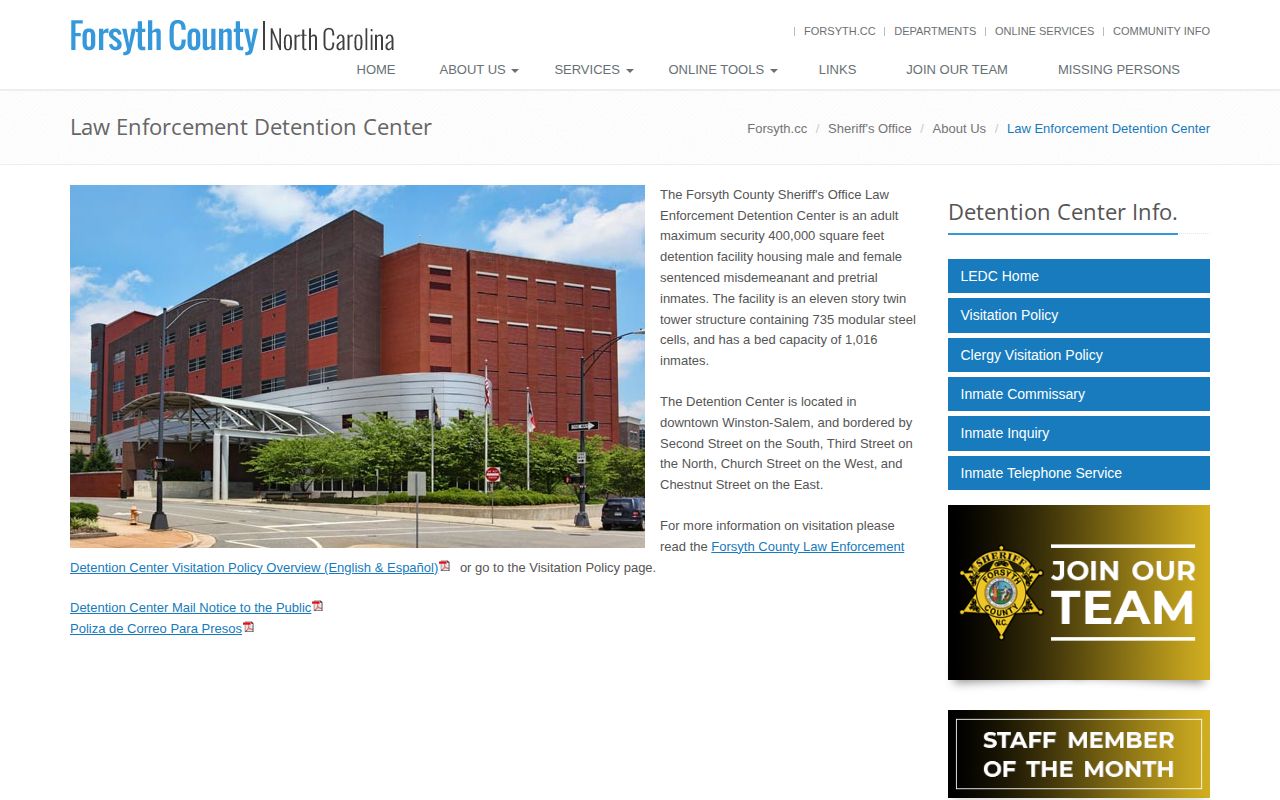
It separates the county jail from unrelated city portals. That distinction keeps a Forsyth County arrest search pointed at the right office instead of a city report system that holds no jail roster.
Search the Forsyth Jail Roster
Start your arrest lookup at the county's Inmate Inquiry catalog. Search with care. A shared name is not always the same person. Once an official result appears, check the booking fields it displays. Bond amounts, facility placement, release dates, and transfer status can all shift after an arrest in Forsyth County. Note the date and Eastern Time of each search too. Jail rosters change fast. A booking entry from this morning may not match what you see tonight.
| Field to check | Why it matters | Limit |
|---|---|---|
| Full name and identifier | Separates people with similar names | Do not infer identity from a photo or name alone |
| Booking date and time | Places the detention event in sequence | Booking time may differ from arrest time |
| Arresting agency | Routes a later records request | Arrest location does not prove residence |
| Charge and bond | Shows the charge and current bond entry | Both may change in court |
| Custody or release status | Shows what the source reports at that moment | A no-match does not prove release |
| Photo, if present | May document the booking identity record | Current FCSO public-photo behavior is unverified |
A careful roster check has three parts:
- Open the current official catalog and note when the search is run.
- Compare spelling, booking date, identifier, agency, and status. Do not rely on one descriptor.
- If no result appears, check alternate spellings and the proper custody system, then contact the detention center or arresting agency.
Custody lists in Forsyth County shift all day. Someone released or transferred can drop off the current view while an agency report, court case, or retained booking record still exists elsewhere. The flip side happens too. A person just arrested may sit in processing before the roster ever shows the name. The sheriff's office makes no promise of instant publication. It guarantees no public booking photo and no fixed window for how long a record stays online. Those gaps are worth knowing before you search.
Note: The LEDC sits at 201 North Church Street in Winston-Salem, and its listed telephone number is 336-917-7600.
Where Forsyth Arrest Records Appear
Every channel tracks a different stage of an arrest record. Start with official sources. A private copy can lag behind a release, a transfer, a correction, or a court decision. The county version wins. Local news adds useful color on a notable arrest. Yet it picks and chooses rather than logging every booking in Forsyth County. Private booking sites still have a place. They can point you toward a date or the likely source record. But they are not county archives, and they never outrank the sheriff, the courts, or whichever agency holds the person in custody.
| Channel | Status | Proper use |
|---|---|---|
| FCSO Inmate Inquiry | Official | Current Forsyth County detention search |
| FCSO or city police records | Official | Arresting-agency report and public record request |
| Forsyth County court and eCourts | Official | Case number, calendar, filed charge, and disposition |
| NC SAVAN/VINELink | Official state service | Eligible custody checks and alerts, not photographs |
| Local news | Independent reporting | Dated context for selected arrests |
| Private booking archives | Unofficial | Secondary leads that require official verification |
The FCSO home page posts more than detention links. It lists crime categories and calls for service across a date range the site displays. Those numbers count reported activity, not arrests or bookings. They cannot be turned into a custody total. Treat the sheriff's home page as the hub where records and detention links begin.
Use its dated labels as written and follow the service link matching your question.
Forsyth Sheriff App Alerts
The Forsyth County Sheriff's Office does offer a mobile app. Just don't expect a jail roster inside it. The Apex Mobile description, along with the Google Play and Apple listings, points elsewhere. It describes issue reporting, online reporting, prevention tips, and community resources instead. Photos you attach to a submitted concern are yours. They are not booking photos. So the app works best as a way to reach the agency. Inmate Inquiry remains the real custody tool.
For a specific person, the VINELink Inmate Check is the practical option. North Carolina runs its version under the name NC SAVAN. It covers participating county jails and Adult Corrections. It does not cover juveniles, mental-health facilities, precinct holding, or anyone who bonds out before reaching a participating jail. A no-match simply means no match. The service tracks custody and notifications, not photos or court outcomes.
Recent Arrests by Forsyth City
Know the agency before you search. Winston-Salem keeps its own police records and Police to Citizen tools. County detention runs through FCSO. Kernersville straddles Forsyth and Guilford counties, so confirm which county handled the event. Clemmons contracts its law enforcement to FCSO and posts no separate village booking roster.
- Winston-Salem Recent Arrests separates WSPD reports and bulletins from FCSO detention and court records.
- Kernersville Recent Arrests explains KPD records, its P2C portal, and the Forsyth/Guilford line.
- Clemmons Recent Arrests routes county custody to FCSO and village administrative records to Clemmons.
Once an arrest turns into a court case, the Forsyth County court page is the official next stop, pulling together criminal calendars, clerk details, and statewide eCourts resources.
Forsyth County Arrest Record Fields
Processing into detention creates a booking record. Expect fields like the person's name, a booking identifier, arrest and booking times, the arresting agency, charge, bond, custody status, and a court reference. Physical descriptors or an identification photograph may appear too. FCSO publishes no fixed field list for its catalog, so rely only on what the official result in front of you actually shows.
- Booking
- The intake process that records identity, charges, property, and custody details.
- Bond
- A court-set condition or amount tied to release while the case is pending. It is not a finding of guilt.
- Disposition
- The court’s later outcome, such as dismissal, acquittal, plea, or judgment.
- Detainer
- A request or legal hold from another authority that can affect release or transfer.
Booked, in custody, released, and convicted are four different things. A released person can still have an arrest record. The court case can still be open. A transfer off one roster does not always end custody either. When a charge appears on a record, follow the case. Check the North Carolina eCourts Portal or the Forsyth County Clerk of Superior Court to see the later result.
Forsyth Mugshots and Booking Photos
North Carolina law lets law enforcement take identification photographs in qualifying arrest and commitment settings. That authority does not create a public online gallery, though. FCSO states no photo policy for its catalog. If an official result shows an image, note whether it belongs to the current booking. Check whether a placeholder is involved. Also see whether the source gives an image date or policy. A copied private image is never an official sheriff-hosted photograph.
No mugshots are hosted or repackaged here. Private sites may display booking images and record fields for Forsyth County. Examples include Busted Newspaper, RecentlyBooked, Arrests.org, Mugshots.com, and Mugshots.zone. Treat them as secondary, because they can be stale, duplicated, incomplete, or wrong. Confirm date, agency, custody status, and court outcome independently. The North Carolina arrest identification statute supplies the legal context for photographs and fingerprints.
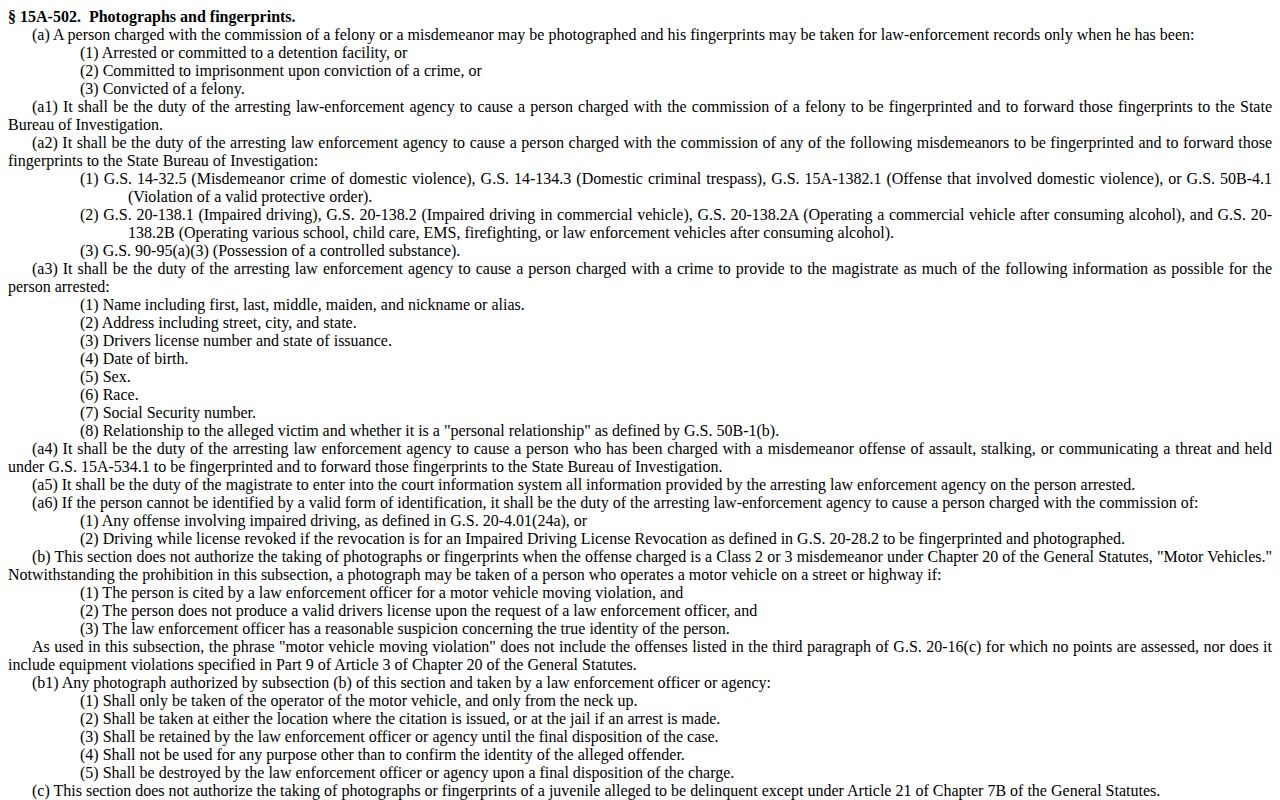
The statute carries limits and special rules. It is not blanket public access to every image.
Request a Forsyth Arrest Record
Sheriff records start with the FCSO Incident Reports instructions. Written requests go to the Records Division, second floor of the Sheriff's Office Administration Building at 301 North Church Street in Winston-Salem. The counter is open weekdays, excluding holidays, from 8:30 a.m. to 5:00 p.m. Bring photo ID. A valid North Carolina driver license or state ID works, along with the initiating report number. Anything filed after 4:00 p.m. gets handled the next business day.
Most walk-in requesters receive only the front page. A full report takes a court order signed by a judge, and suspects or offenders cannot get copies without one. Juvenile reports require a parent or legal guardian plus a birth certificate. FCSO also points people back to the agency that made the arrest. A WSPD arrest may sit with Winston-Salem records instead, and WSPD calls its route free of charge but uncertified, with no disposition included. Kernersville Police matters belong with KPD. The sheriff's office publishes no booking-photo fee, response-time promise, or photo release rule for the public.
- Identify the arresting agency, approximate date, person, and report or booking number if known.
- Ask for the exact public record needed, such as the incident front page, arrest record, or identification photograph.
- Follow the custodian’s identification, written-request, redaction, court-order, and current fee rules.
- Use the court file separately for certified case information and disposition.
The official FCSO request page shows the agency-specific requirements.
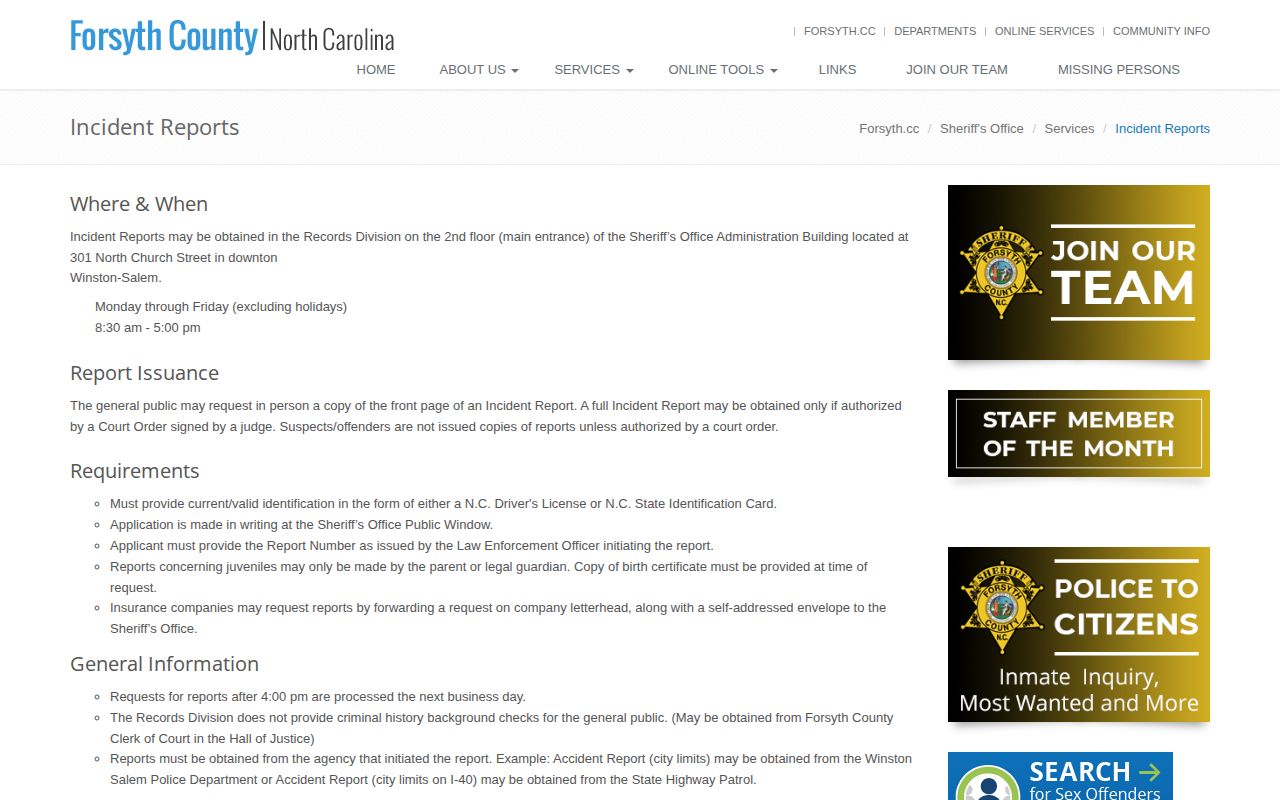
Note: Check the report number, your identification, the time of request, and the initiating agency first.
North Carolina Public Records Law
G.S. 132-1 takes a wide view of what counts as a public record. Papers, photos, and electronic files created or received in the course of public business all qualify. G.S. 132-1.4 narrows in on criminal investigations. It spells out arrest details the public can generally see. Think time, date, and place. The nature of the alleged violation counts, too, along with certain facts about the person arrested. Still, the law leaves room for limits. A court order or another statute can hold records back to protect an investigation, a prosecution, or fair-trial rights.
Juvenile material sits on a different shelf. KPD's records guidance says juvenile reports need a court order or similar legal paperwork before release. G.S. 15A-502 adds its own juvenile and traffic provisions. So "public record" never means every report, photo, or investigative detail comes out in every case.
Retention rules add another layer. The state sheriff schedule treats booking photos, criminal-history files, incarceration records, inmate lists, and daily bulletins as separate series. Identification photos held outside a case file may be destroyed after three years. Photos inside a case file follow that case's own schedule. Incarceration records can go three years after release or transfer. Weekly inmate lists survive until obsolete or superseded. None of this promises an online photo vanishes on a schedule, and private copies are another matter entirely.
Correcting Forsyth Record Copies
Fix the error at its source first. Confirm the court case and its outcome. Then ask the official custodian how a correction or court order changes the record. North Carolina's official expunction guidance ties eligibility and timing to the law and the case result. An expunction can require state records to be sealed or destroyed. It is not automatic. News stories, search results, and private copies may persist anyway.
Two forms show the pattern. AOC-CR-287 covers certain dismissed charges. AOC-CR-288 covers certain not-guilty or not-responsible results. They are examples, not universal forms. Filing happens in the county where the charge or conviction arose.
Once an official source changes, use each search engine's outdated-content refresh process and each private publisher's lawful, free correction path. RecentlyBooked and Mugshots.com publish document-based maintenance policies. Arrests.org and Mugshots.zone expose request routes; check their current requirements. Never pay anyone promising guaranteed removal. Two state proposals, HB 778 from 2023 and HB 446 from 2025, never became law. Neither is a current anti-pay-to-remove statute.
Forsyth Warrants and Wanted Persons
The sheriff's office runs an official Wanted Persons catalog through its police-to-citizen portal. The page is dynamic. It pulls listings on the spot. No fixed count, refresh pace, or photo policy can be quoted here. Treat any older tally as stale. Also remember the difference. A wanted listing points to an unresolved warrant, not a jail booking from a new arrest. The official wanted-person source is the portal itself. That is where current Forsyth County listings live.
Open the live source directly to check a status. A copied list is not verification. Never approach a listed person. For a personal warrant concern, talk to an attorney or the appropriate court and arrange a lawful resolution. Call 911 for immediate danger. The sheriff lists 336-727-2112 for non-emergency information from outside the county. Crimestoppers, at 727-2800, takes tips about past crimes that may lead to an arrest or conviction.
After a Forsyth County Arrest
FCSO Victim Services lays out what happens next. After an arrest, the defendant goes before a magistrate or judge. That official sets bond and a court date. An arraignment is the early appearance where charges and procedure are addressed. A booking record marks the intake stage, not the case's end. Bond amounts can change. Charges can be amended. Cases even get dismissed later.
Court records live elsewhere. The Forsyth County court page offers local court directories and calendars, with case search on the eCourts Portal where available. Nonconfidential records can also be requested through the clerk, following the process North Carolina Courts describes. A certified court record differs from an agency arrest printout. WSPD states plainly that its arrest records are not certified and carry no dispositions.
Custody Beyond Forsyth County
County custody is only one stop. Someone arrested in Forsyth County can move on quickly. Each stage has its own keeper. The downtown detention center is separate from Forsyth Correctional Center. The facility is state-run and minimum-custody, a reentry facility for men with room for 248. A hit in the North Carolina Department of Adult Correction system points to prison or supervised release. It does not signal a fresh county arrest. NC SAVAN can send alerts across some jails and adult-corrections sites. Its coverage has limits, though.
Federal custody works differently. The Federal Bureau of Prisons locator finds federal prisoners by name or number. It does not hand out booking photos. ICE runs its own Online Detainee Locator for immigration holds. A "federal" tag on a county record proves neither one. When a locator comes up empty, the BOP accepts written records requests.
No match does not mean no arrest. Transfers, releases, misspelled names, and lagging data all hide people. Ask the office that owns that custody stage. That habit works for Forsyth County recent arrests. It also works for state prison, federal lockup, and ICE detention alike.
Forsyth County Sheriff’s Office Location and Directions
Public Record Search
Sponsored Results