
Forsyth Arrest Log Sources
Forsyth County publishes no single page that promises a complete countywide weekly booking list. The official trail begins with the current FCSO Police to Citizen portal. A 2009 county announcement described the earlier system as supporting name, date, and location searches. It covered incidents, arrests, wanted people, and inmate information. That old design says nothing about today's filters, date depth, or retention.
Trust the label on the screen. An inmate catalog is a custody tool. A daily bulletin mixes in incidents, warrants, wanted entries, stolen vehicles, and missing-person reports. A police summary search tracks one agency's events. None of these should be renamed a county jail blotter. The name applies only if the official page says so. For a same-day custody snapshot, the Daily Arrest Report is the narrower route.
Read Forsyth Dated Records
Work backward from official agency records, then add court filings and secondary context. Note the source, agency, record type, event date, and access date for every item. That habit keeps an old page from looking current.
- Check FCSO P2C for the county arrest, incident, or inmate history that its live interface actually offers.
- For Winston-Salem, use the WSPD Summary and event search, keeping it separate from county jail custody.
- For Kernersville, open the KPD Police to Citizen portal. Its records channel may receive reports after officer filing.
- For Clemmons law enforcement, route through FCSO because the village contracts policing to the sheriff.
- Confirm filed charges and their result through North Carolina courts rather than an arrest listing.
The FCSO keeps both a current and a legacy application for its dated records. Neither one points to a dead service. The current fields simply work best in an ordinary browser, so a visit to the sheriff's site is the practical route for Forsyth County arrest details. The older `p2c.fcso.us` addresses belong in historical notes rather than in any claim about a live weekly archive.
Forsyth Log Entry Meanings
Fields vary by source. The table below separates an agency event, a jail record, and the later court case. Leave absent fields blank rather than borrowing from a private copy.
| Field | Reading rule |
|---|---|
| Event date/time | Do not substitute it for booking time. |
| Agency | Preserve FCSO, WSPD, KPD, state, or federal ownership. |
| Report or booking number | Use the number tied to that record type. |
| Alleged charge | It may change before filing or disposition. |
| Bond | It is a changeable condition, not a guilt finding. |
| Custody label | Check whether it means booked, confined, released, or transferred. |
| Photo | Record provenance; no official current FCSO photo policy was confirmed. |
WSPD says its arrest records are uncertified and omit dispositions. The Forsyth County Clerk of Superior Court holds the later court record. A docket can show a charge dismissed, amended, resolved, or still pending; a roster never answers that question.
Agency Portals Are Not Identical
FCSO and WSPD run related Police to Citizen-style interfaces on separate systems. The look-alike design hides a real boundary. WSPD's Summary is a city incident path. FCSO's inmate catalog is the county detention path. KPD's portal covers Kernersville police reports, while a Forsyth-side custody event may still lead to LEDC.
For a city arrest report, start by identifying the initiating agency. FCSO's incident-report process allows an in-person request for a public front page. The full report needs a court order, it says. WSPD has its own arrest-record request. KPD warns that sensitive material can be withheld from its public copy. These differing access rules are one reason no weekly log can be built by copying a single roster.
Unofficial Forsyth Arrest Archives
Private sites can help you pin down a possible date. But they follow their own update and archive rules. One booking may be duplicated. A page may linger after release. Records may be missing, and date meanings can differ. Rank them behind FCSO, the arresting agency, and the court portal. Never add their counts together. The Busted Newspaper Forsyth section displays booking details and images attributed to FCSO. Its pages can sit for weeks without new material.
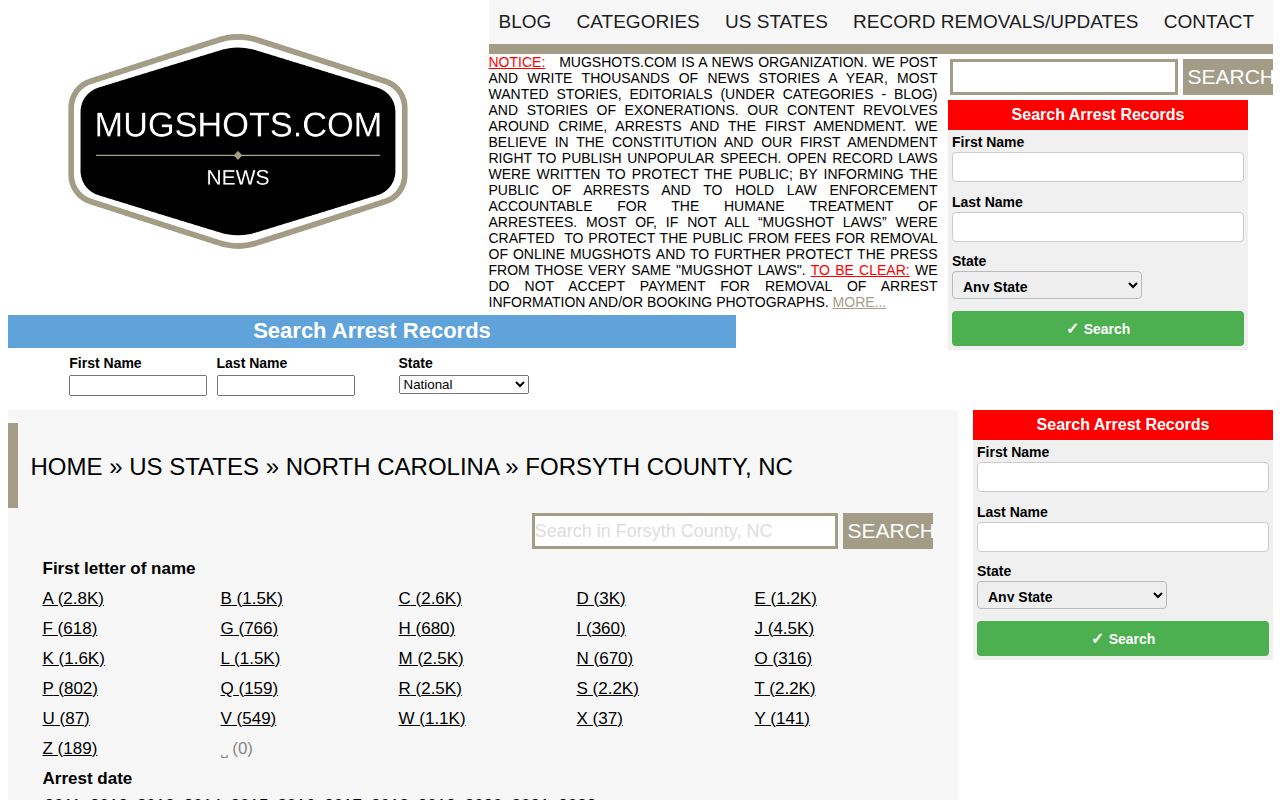
The page offers a dated lead only, not the sheriff's live roster. The Mugshots.com Forsyth index provides county and city navigation but no dependable official update timestamp.
This is an archive interface, not an official county feed. The Mugshots.zone Forsyth page shows a recent list and monthly navigation while warning of possible error or delay.
Use a displayed date to find the official record, then verify status with FCSO and the court.
When “Recent” Dates Disagree
Secondary services refresh on their own schedules, so "recent" means different things on different pages. One archive can carry month-old entries. Another posts same-week snapshots with its own counts and update claims. That mismatch argues against treating "recent" as a shared time window. Save the visible timestamp. Never repeat a private count as though it came from FCSO.
Arrests.org provides daily navigation. It also uses labels such as "out of custody" or "federal inmate." Those are private-site labels. Confirm county custody with FCSO. Check state custody with NCDAC and federal custody through the relevant federal locator. A lingering archive page does not mean someone remains in jail.
Note: A source's posting date, booking date, arrest date, and last-updated date can describe four different moments.
Statistics Are Not Arrest Logs
Numbers can trick you. The Forsyth County Sheriff's Office posts crime categories and calls for service. Clemmons offers an older contracted-policing activity table. None of that equals booking totals. Offenses, calls, citations, and arrests are different measures, and a single incident can spawn several records.
The Clemmons table spans December 2019 through November 2020, making it historical context rather than a live count. There is no ongoing official feed for enforcement blitzes. A press release tallies arrests from one initiative, and the dated WXII operation report shows how selective that coverage is.
Forsyth Archives Beyond the Window
North Carolina's sheriff records schedule treats daily bulletins, inmate incarceration records, and identification photographs as separate series. What a web portal displays is not the same as what the government keeps. An entry can vanish from search. That does not prove the record was destroyed, sealed, or expunged.
For older material, ask the agency for its record. Use the court case as the disposition source. Local newspapers add dated context too. Coverage there is selective. The North Carolina Archives newspaper guide helps you locate historic holdings. Search by date and agency. Then verify the underlying public record.
Forsyth Record Retention Map
North Carolina's official sheriff records schedule beats any private site's archive navigation. It splits sheriff paperwork into separate series. Daily bulletins, inmate incarceration files, identification photographs, felony case files, misdemeanor case files, and weekly inmate-list reports each get their own rules. The schedule dates to 2015. It frames record-keeping statewide, not what the FCSO portal exposes to the public. Audits or expected litigation can pause scheduled destruction.
Inmate incarceration records can hold entry and release summaries, arrest sheets, commitment and release orders, and pretrial release agreements. Their listed disposition is three years after release or transfer. Weekly inmate-list reports may go when superseded or obsolete. Bulletins cover stolen vehicles, missing people, and wanted suspects. They stay on file while they keep reference value. That is why a bulletin archive cannot replace a weekly booking ledger.
Identification photographs outside a case file carry a stated three-year disposition. Photos inside a case follow that case's schedule. Solved felony case histories carry a listed 20-year period. Misdemeanor case histories generally follow a shorter three-year rule after set conditions. These are government records rules, not guaranteed web access. A copied image vanishing from one site says nothing about the official file.
Start by identifying the record series. Then file your request with the right Forsyth agency. The clerk holds the case disposition. Treat newspaper indexes as discovery aids only. A missing portal page proves neither that the arrest never happened nor that the underlying record was expunged.
Public Record Search
Sponsored Results